


Embracing Bangladesh as their adopted home, American couple Jacob and Joya Berlin have built Action Joy Enterprise, a social venture that helps trafficking victims and trauma survivors heal and also reclaim their lives by earning a dignified living through intricate handicrafts
Soon after the Sundarban Express chugs out of Dhaka Railway Station on a humid June morning, Jacob Berlin recalls how excited he was to board his first flight to Bangladesh back in 2011. As a German-born American, he had already taught English in West Africa for two years after finishing university. Then he crossed continents again to do the same for three months in the southern coastal district of Patuakhali under a development project.
“I was single and carefree. I was not sure what it would be like, but I had nothing to worry about,” he says, sitting next to me on one of the lower berths of the sleeping car, which has a white interior.
It did not cross his mind at the time that he would one day trade his home in the US for the unknowns of Bangladesh. But as days passed, he was enthralled by the South Asian country where acquiring American citizenship is often understood as a symbol of upward social mobility. He was so into Bangladesh that he returned to America after the stint, married Joya Berlin, whom he had known since university, and coaxed her into moving here to build a future together.
Joya sits across from me by the large window and is dressed in a black kurta with red floral patterns, blue jeans, and a red dupatta. Scattered across the four berths upholstered with light green fabric, the couple’s five adorable children – Elijah, Grace, Mercy, Lilia, and Amy – frolic. On our way to the blue truss bridge over the vital Buriganga River, clusters of residential and commercial units dominate the cityscape in the bustling neighbourhoods of Gandaria, Jurain, and Shyampur.
This high population density in Bangladesh often overwhelms foreigners initially, but it was a pure blessing for Joya. She is from Alaska, which is nearly 10 times larger than Bangladesh but home to fewer than a million people. Moving here, she not only found some “good friends” but also the ideal space to pursue her passion for humanity.
“I love people. I always wanted to go to a low-income country where I could help people. When I came here, I had a save-the-world kind of attitude,” Joya says fervently, positioning herself so as not to bump her head against the upper berth.
Pouches are nicely arranged on hanging rope shelves in the Action Joy showroom in Faridpur’s Jhiltuli. — FE photo
That mindset, coupled with strenuous efforts and undying love for Bangladesh, materialised into Action Joy Enterprise Ltd, a social initiative to empower disadvantaged women through art, design, and handicrafts. But it is much more than a conventional handicraft producer as most of the artisans are trauma survivors and victims of sex trafficking. The company offers art therapy and counselling to help the women recover and then give them vocational training to earn a dignified living and take control of their lives.
Joya is the chief executive officer of Action Joy, which she founded in 2021 with a small capital, while Jacob serves as the managing director. The management team consists of 40 people. The company runs two small production houses in Faridpur, where we are heading today.
The Action Joy idea was born when Joya visited a rehabilitation centre in Faridpur at the invitation of the Department of Social Services in 2019 and encountered some 40 girls who had been trafficked. While volunteering as a counsellor for the girls, she also visited local brothels. There she witnessed the shocking commodification of women and children.
“They [rehabilitation centre girls] literally had nothing. They showed me their pillow and blanket, and they wanted me to touch those because that was all they had,” she says poignantly.
An irresistible urge to reduce their plight in the absence of permanent support from non-governmental organisations (NGOs) led her to extensively research how she could intervene. It was obvious that assistance offered by forming a typical NGO would only reinforce a cycle of dependency rather than fostering independence. For a sustainable pathway to freedom, these women needed to heal emotionally and learn income-generating skills to get a second chance in life.
Today, they craft a broad range of products, including bags, table runners, cushion covers, apparel, and earrings, and these are sold to customers as far away as the US. After receiving counselling and handicraft training, most of them work independently at home with sewing machines provided by Action Joy, while many also stitch with their hands, especially in slums. At one point, as many as 2,000 women were involved with the enterprise.
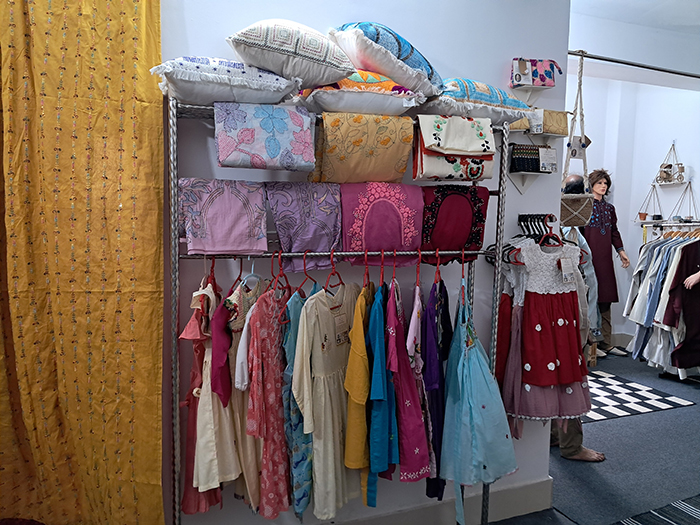
A metal rack holds children's apparel, throw pillows, and salwar kameez. — FE photo
Joya, herself a designer, has guided the women on a lot of designs, and there is a guideline for them to follow. But for random art, they are free to express their own creativity. She claims that the products are unique because of their colours, designs, and stitching patterns, but what truly sets them apart is the artisans.
“It is actually their stories. We are turning their stories into products. I am most proud of this uniqueness,” says Joya, who is also a life coach and trauma counsellor.
Action Joy has a strict two-stage quality control (QC) process. The head of QC in Faridpur is responsible for the first round of checks. The final checks take place in Dhaka before the products go on sale.
To ship products to customers, the cheapest and most convenient option is chosen based on the destination. Those in the US mostly get it through courier services for orders involving small volumes. Rental pickup trucks are used for bulk orders, such as those placed by big chains.
“The response from Bangladeshi customers has been very positive as well, but we could not sell a lot here due to the high prices. We pay the artisans a lot, and you have to add the cost of counselling as well,” Joya observes.
The artisans can earn up to Tk 30,000 a month if they are motivated enough. Such a handsome income is possible as Joya bypasses the exploitative middleman structure, which is widespread in Bangladesh. During her field research in Jashore, she was offered an intricately designed saree at a wholesale price of Tk 1,200, but was shocked to learn that the weaver would get only Tk 300 although it took more than a month to make the garment.
To protect her workers from such deprivation, she designed a supply chain where products move directly from the craftswomen to the business. Any intermediaries she works with are paid a flat fee for their services. However, they cannot cut into the artisans’ earnings.
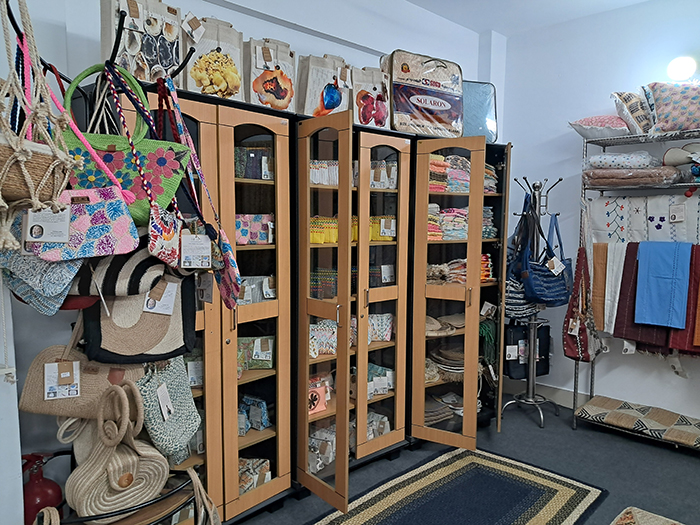
Three big wooden cabinets display handbags and folded textiles. — FE photo
The outside view indicates we are approaching the landmark Padma Bridge, and the junior Berlins joyfully scream the moment the train gets on it. Joya turns her eyes to the wide expanse of the water and recalls the ordeal of spending 12 hours to cross the river by ferry, which included a long waiting period to get on the vessel. It turned into her worst nightmare when she was in a queue to go to the toilet and suddenly noticed the bus was leaving.
“I was eight months pregnant, and I was chasing the bus. After running for around a mile, I caught it and got on the ferry,” she laughs.
Before she started the business, her research revealed that most Bangladeshi products were made with Chinese raw materials. However, she was determined not to import anything from China. The majority of her merchandise is made of locally sourced jute and cotton, though other eco-friendly materials are also used.
“I am trying to help Bangladesh export its own stuff,” Joya notes.
This has not been easy, though. Beyond regulatory hurdles and heavy taxation in both countries, securing fair prices and ensuring transparency are constant challenges. As a foreign entrepreneur, she has also dealt with people's unreasonable expectations.
Because she is from the West, many assume she has lots of money and will offer high salaries without hard work. She has hired people with impressive resumes on LinkedIn, only to find out they cannot do the job. Now she relies on personal recommendations, but building networks in the local community has been difficult.
Other major problems are workplace nepotism and cultural differences in management. In the US, she can hire a manager to handle a role on their own, but managers here have often preferred being told exactly what to do. This top-down approach has compelled her to micromanage daily operations.
She believes the government can ease running a business for foreign private investors like her by cutting the high taxes and relaxing the strict rules. Such investors’ earnings are heavily taxed, and they are required to hire 20 local workers right at the beginning of the venture. Navigating the red tape, including getting security clearances, takes two to three years, causing most entrepreneurs to burn out.
“You will also face corruption. I never paid ghoosh (bribes), though things would have been easier if I did. I am kind of starting a movement. I want people to stick to business ethics, and I am very strict about our core values,” she asserts, quipping that she is “ghoosh-free”.
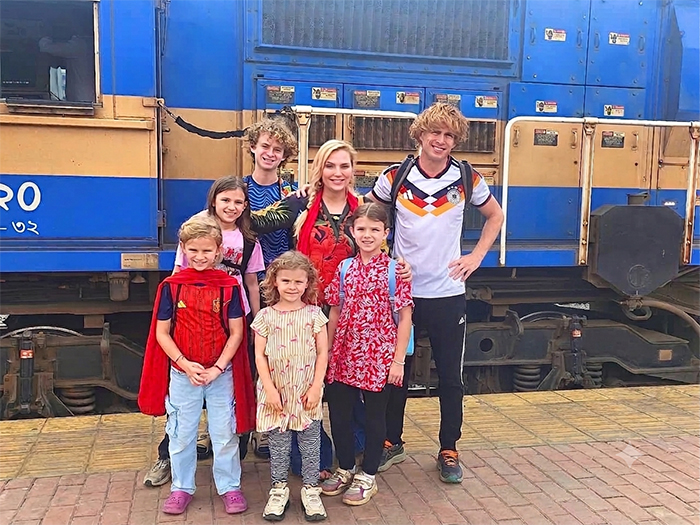
Action Joy Managing Director Jacob Berlin, Chief Executive Officer Joya Berlin, and their five children stand in front of a locomotive on the platform of Dhaka Railway Station. — FE photo
Action Joy regularly develops new products and utilises recycled materials. It recently made some items using old sarees. With a vision to bring therapeutic work to people across the globe, it is working on expanding its footprint beyond the US market.
Pursuing such a grand vision entails many hurdles. I ask Joya what keeps her motivated when things get difficult and Jacob, who is wearing a jersey of the German football team, jokingly chimes in, “A good-looking husband”. A gale of laughter erupts in the cabin and Joya teases him back, calling him a “socially awkward” person who walks around eating food in front of people all the time.
She then takes on a serious tone and says, “Honestly, the investment is what keeps me going, but it is not the money. Apart from investing my young life here, I have also given up my family and my country.”
The couple have been under immense financial stress this year. Most of their investments are exhausted, while Joya has gone through health struggles, including a back surgery. She could have taken a more balanced approach to life and business, but she does not regret her current situation.
Just as the Padma Bridge has connected the southwestern region with Dhaka, learning Bengali has helped the couple and their children integrate well into the culture. It was a “very enjoyable” experience for Jacob, who followed a structured method, and “much harder” for Joya, who mostly learned by interacting with Bangladeshis. Now they feel more at home and enjoy nattering with locals.
“Fortunately or unfortunately, I am kind of not American anymore,” Joya admits.
The hospitality and the food are what Jacob loves most about Bangladesh. Dim paratha (fried flatbread with eggs), dal (lentil), and bhaji (fried vegetables) are among his favourites, while Joya likes duck. They follow a hybrid menu of Bangladeshi and foreign dishes at home.
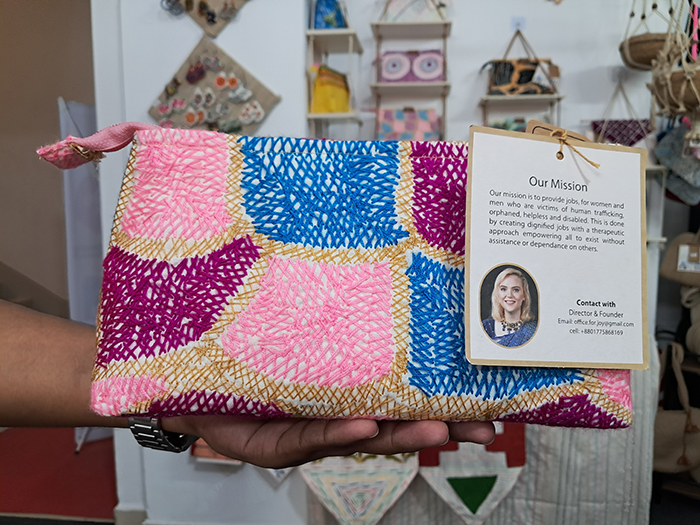
An embroidered pouch made by Action Joy. — FE photo
Riding a train through Faridpur, which is nestled along the bank of the Padma, is like watching a slideshow of paintings that reflect the timeless charms of rural Bangladesh described by Palli Kabi (Rural Poet) Jasimuddin, who was born in the district. During the final leg of our journey from Bhanga to Faridpur, long stretches of croplands fringe occasional small waterbodies. Tin-roofed houses often pop up among lush vegetation.
This is the best part of living in Bangladesh, says Jacob, pointing to the expanse of greenery. He says it is therapeutic for the eyes. During his time in Sub-Saharan Africa, he had not seen so much green.
He loves rural Bangladesh because of the greenery, and so does Joya, who grew up in the Rocky Mountains in a family of 15 siblings and moved to Alaska in her teens. Alaska is beautiful in her eyes, but she did not mind leaving it for Bangladesh. She was a little depressed during her first year here as she pined for her family, but noticing the diverse patterns in people's outfits while riding rickshaws provided a respite.
Jacob praises trains as the safest mode of transportation in Bangladesh. His longest journey, from Kolkata to Varanasi, lasted over 24 hours. He remembers putting coins on the tracks as a child to see what happened when trains rushed away.
Known as Bangladesh’s jute capital, Faridpur came under the railway network in the British era, but services were closed in the 90s. The new station building, which has a distinct look with its light blue colour and arches, was built in the 2010s under the Padma Bridge rail link project. After we disembark from the train, Action Joy officials greet us with bouquets on the platform.
A bumpy autorickshaw ride takes us to a house in Bilmamudpur, a tranquil village where I hear birds chirping. Behind a sturdy silver-coloured gate stands the three-storey building, its exterior painted in light blue and light orange, with trees in the front yard rising above the boundary wall. It is used as both the office of Bijoy International, an entity under Action Joy, and the residence of the Berlin family.
After having breakfast with flatbread and eggs, Joya takes me to West Khabaspur, where the Action Joy training centre is located on the ground floor of a bright blue four-storey building. A large banner featuring her in a blue saree is mounted on the exterior wall. Master trainer Robiul Sheikh, who has over 20 years of experience, briefs me on the activities of the centre.
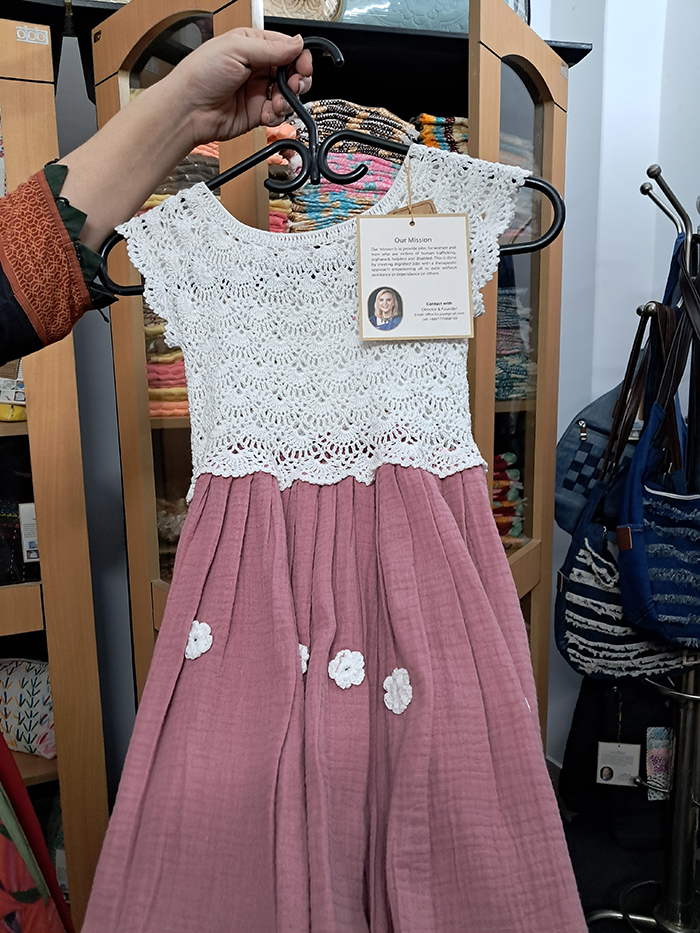
Children’s apparel made by Action Joy. — FE photo
Action Joy not only trains trauma survivors but also other women willing to learn the craft, and Asmani Khatun is one of them. She is from Boalmari upazila and has been involved with Action Joy for three years. She now makes bags but has experience working with various products, including cushion covers and bracelets.
She used to do home-based tailoring work before joining Action Joy. She gets paid based on the products she makes. The highest she made in a month was Tk 18,000.
“The work environment is good here, and the people are nice. We get clear instructions, do the work accordingly, and deliver it. I am happy to work here,” she tells The Financial Express.
Action Joy has helped her progress in life. She has also learned a lot by working here. Armed with the training and experience, she thinks she can build a handicraft business on her own in the future.
Masuda Akhtari feels the same way, saying the nice work environment is the best part of Action Joy. She has been working here for two years. She has learned how to make three types of bags and do hand stitching.
She was previously a housewife and had no income. Action Joy has empowered her financially, and now she can contribute to the family. Her highest monthly earnings reached Tk 10,000.
“There is no problem here. Our instructor guides us well. I was trained for three months. They gave me a sewing machine, and I work with that at home,” she adds.
Joya explains that Action Joy is also doing community service by providing the training. Sometimes 30-60 women come here in a month for the training, but Action Joy cannot take them all as artisans. Those trainees can find work elsewhere.
We then make our way to the Action Joy showroom in Jhiltuli, an upscale neighbourhood that locals compare with Gulshan because of its modern buildings and cosy eateries. Situated on the third floor of a white multi-storey building, the showroom has an artisanal atmosphere and displays an array of stylish, bright-coloured handcrafted merchandise. Visitors cannot help but admire the meticulous craftsmanship of each item as they explore the homey space.
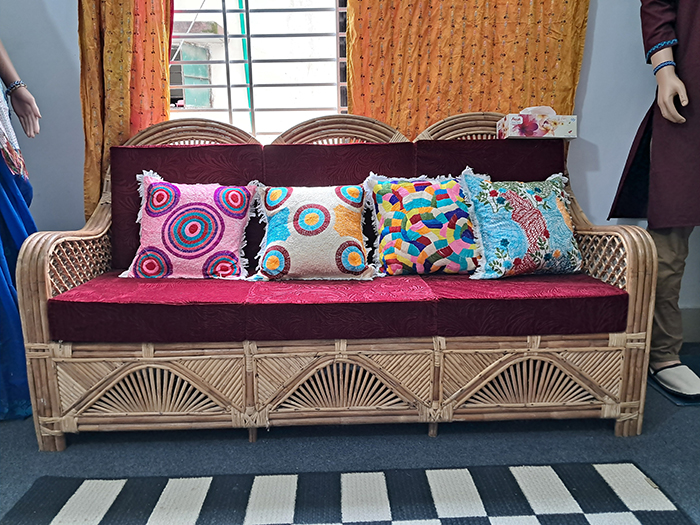
Vibrant throw pillows made by Action Joy are showcased on a cane sofa with deep red cushions. — FE photo
Embroidered pouches, with prices starting from Tk 800 for two pieces, are nicely arranged on wall-mounted and hanging rope shelves. Tote bags made of jute hang from metal pegs and hatstands, and are priced between Tk 600 and Tk 3,000. Three diamond-shaped boards, mounted one above the other on a wall, display earrings of different patterns that cost Tk 250-800.
Three big wooden cabinets lining another wall have more handbags and folded textiles. A metal rack on the opposite side holds children's apparel, throw pillows, and salwar kameez. Bracelets and some other accessories are presented on a table draped with a quilt.
A cane sofa with deep red cushions and vibrant throw pillows looks inviting. On each side of it stands a mannequin – the male one dressed in a maroon punjabi and dark olive pants, and the female one in a blue saree and a white blouse. Nearby, punjabis with delicate designs hang from wooden hangers on a metal rack.
Behind each of these products, there is a story of hope and resilience that involves not only the artisans but also Joya herself. After selling everything in the US to build a life in her adopted home, she has so far lost around $1 million and been deceived while running the business. Yet, she stays the course because “someone has to be there for the women”.
r2000.gp@gmail.com
