


Residents of Rajshahi city continue to suffer as most paved footpaths across key urban areas remain illegally occupied, forcing pedestrians onto busy roads and raising serious safety concerns amid weak enforcement and allegations of organised extortion.
Urban specialists and residents blamed weak enforcement, lack of coordinated efforts among authorities, absence of designated vending zones and limited political will for the persistent encroachment.
Visits to major areas, including Shaheb Bazar, Laxmipur, New Market and Railgate, found sidewalks largely taken over by shop extensions, street vendors, makeshift stalls and parked vehicles.
In many places, footpaths have effectively turned into informal commercial spaces, leaving little or no room for pedestrians.
As a result, commuters, schoolchildren and other residents are increasingly forced to walk along busy roads alongside moving vehicles.
Residents said that the situation has made daily movement both difficult and dangerous, particularly during peak hours.
‘Footpaths are no longer usable. We have to walk on the roads every day, which is extremely risky,’ said school teacher Shawkat Hossain.
Guardians expressed concern over children’s safety, while elderly people and persons with disabilities were seen navigating congested streets with difficulty.
Ferdausi Rahman, a guardian, said that she had to accompany her daughter to school and coaching classes by walking on busy roads due to the occupation of footpaths.
A recent academic study rated Rajshahi’s walkability at just 43.20 out of 100, placing it in the ‘not walkable’ category, with infrastructure for vulnerable groups scoring even lower.
Residents and local observers alleged that the persistence of encroachment was linked to systemic extortion and political backing.
According to them, vendors are often allowed to occupy public spaces in exchange for daily payments ranging from Tk 50 to Tk 200 depending on location.
‘Those who occupy footpaths often have political backing. Even small vendors are forced to pay to run their business,’ said Dipak Das, president of the Rajshahi district unit of Socheton Nagorik Committee.
Emdadul Haque Lemon, member secretary of Rajshahi City College Chhatra Dal who shared a post of his Facebook wall last month over extortion from footpath vendors, said that opportunistic groups were exploiting both public space and vulnerable vendors.
‘Footpaths are being occupied, and at the same time, money is being collected from those who have no other means of livelihood,’ he said, calling for accountability regardless of political affiliation.
Urban planning experts said that the problem reflects deeper structural issues, including the absence of designated vending zones, weak enforcement continuity and poor coordination among authorities.
‘Eviction drives are carried out occasionally, but without sustained monitoring, footpaths are reoccupied within hours,’ said Muhaiminul Islam, an assistant professor of urban and regional planning at Rajshahi University of Engineering and Technology.
He added that the lack of rehabilitation plans for informal vendors continues to perpetuate the cycle of encroachment.
Experts also pointed to increasing commercial pressure in busy areas, where formal businesses often extend operations onto sidewalks, further shrinking pedestrian space.
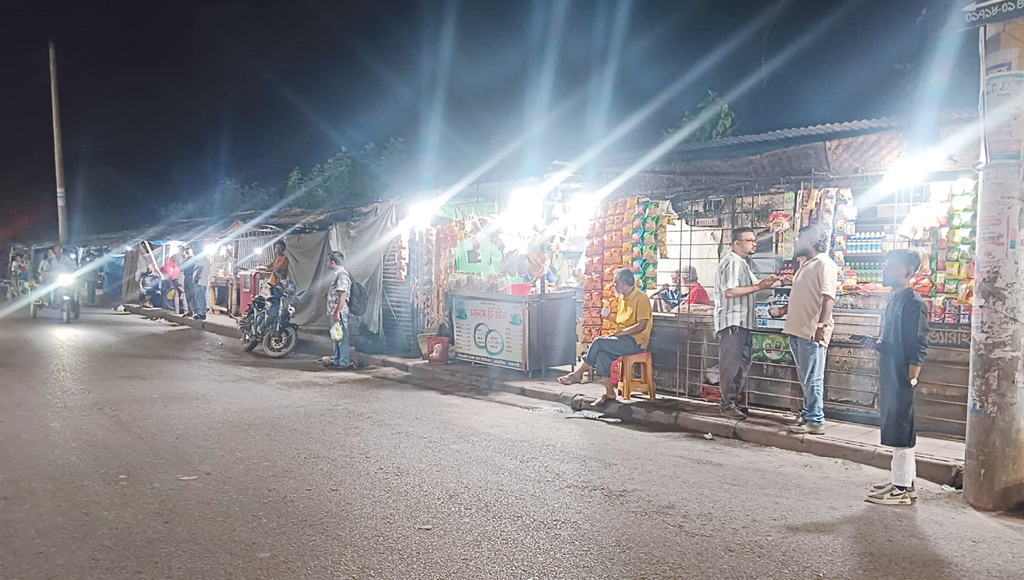 Makeshift shops are set up occupying a road near the Rajshahi Railway Staion in the city. The photo is taken on Friday. — New Age photos
Officials of the Rajshahi City Corporation said that eviction drives and mobile courts were being conducted regularly.
‘We are taking action against illegal occupation, but maintaining clear footpaths requires cooperation from all stakeholders,’ said chief executive officer Rejaul Karim, admitting that reoccupation remains a major challenge.
Residents, however, said that such measures have failed to bring lasting relief.
‘Authorities clear the footpaths, but within a day or two, everything returns to how it was,’ said Abdur Razzak, a resident of Laxmipur.
Experts warned that continued encroachment undermines pedestrian rights, increases accident risks and affects overall urban liveability.
They recommended stricter enforcement, including confiscation of goods and higher penalties for repeat offenders, alongside planned relocation of vendors and a comprehensive urban management strategy.
Without sustained and coordinated intervention, they cautioned, Rajshahi’s footpaths will remain under illegal occupation, leaving pedestrians exposed to growing risks.
