


The Middle East was thrust into its most dangerous military confrontation in decades after Iranian missile and drone attacks killed three US soldiers and left five seriously wounded across the region, while at least nine people were killed in a strike on the Israeli town of Beit Shemesh, according to US Central Command and Israeli authorities.
The escalation followed sweeping US and Israeli strikes that Iranian state media say killed Supreme Leader Ayatollah Ali Khamenei and several top security officials, triggering a wave of retaliatory attacks by the Revolutionary Guard Corps against what it described as 27 bases hosting US troops across the Middle East, as well as Israeli military facilities in Tel Aviv.
Explosions were reported through the day in Qatar and the United Arab Emirates as air defences intercepted incoming missiles.
Iran’s government announced that an interim council led by President Masoud Pezeshkian would oversee state affairs until a new supreme leader is selected, as state media reported at least 201 people killed across 24 provinces in the US-Israeli assault.
US President Donald Trump warned Tehran it would be struck “with a force that has never been seen before” if it escalated further, while Iran declared US and Israeli assets across the region legitimate targets.
Tehran’s retaliatory strikes extended beyond Israel to US military installations and strategic sites in Qatar, the UAE, Kuwait, Bahrain, Jordan, Saudi Arabia, Iraq and Oman, widening the battlefield and raising fears of a regional war engulfing the Gulf.
From shortly after midnight, sirens and blasts echoed across multiple capitals.
Residents in Doha reported loud explosions near the Al Udeid Air Base, the forward headquarters of US Central Command’s air component and a hub for coalition operations.
Qatari authorities said their air defences intercepted incoming missiles, though debris fell in some areas.
In the United Arab Emirates, witnesses described streaks across the sky and repeated detonations as defences engaged projectiles believed to be part of Iran’s retaliatory barrage.
The UAE said it had intercepted two rounds of attacks and reserved “the full right to respond,” calling the strikes a dangerous escalation.
Bahrain confirmed that an Iranian missile attack targeted facilities associated with the US Navy’s Fifth Fleet, headquartered in Manama.
Kuwait reported intercepting missiles aimed at Ali al-Salem Air Base, while Saudi Arabia and Jordan said their air defence systems were activated in response to projectiles crossing or approaching their airspace.
Iraqi security sources reported explosions near the US consulate in Arbil, capital of the autonomous Kurdish region, where American forces are stationed as part of the international coalition against the Islamic State group. In Oman, which has acted as a mediator in past US-Iran talks, officials confirmed heightened security measures but did not report confirmed impacts.
In Israel, air raid sirens sounded repeatedly as Iranian missiles targeted military facilities and urban areas.
Authorities said at least nine people were killed in Beit Shemesh, a town west of Jerusalem, after a missile struck a residential area. Emergency crews worked through the morning to clear rubble and treat the wounded.
Israeli officials said several projectiles were intercepted, but some penetrated defences.
The military confirmed that Iranian missiles had targeted sites in Tel Aviv described by Tehran as military facilities.
The Israeli government said it would continue operations against Iran, arguing that its earlier strikes were aimed at neutralizing what it called an existential threat.
The reported killing of Ayatollah Khamenei marks a seismic shift in Iran’s political structure.
Iranian state media said the supreme leader and several senior security officials were killed in the initial wave of US-Israeli attacks, though independent verification remains limited.
In an emergency address, Iranian authorities announced that an interim governing council composed of senior officials, including President Masoud Pezeshkian, would oversee state affairs until the Assembly of Experts selects a new supreme leader in accordance with the constitution.
The Revolutionary Guard Corps (IRGC) vowed revenge, stating that “all American and Israeli assets and interests in the Middle East have become legitimate targets.”
It said it had launched attacks on 27 bases hosting US forces, in addition to Israeli military facilities.
US Central Command confirmed that three American service members were killed and five seriously wounded in Iranian attacks across the region — the first publicly acknowledged US combat deaths in the current escalation.
President Donald Trump, speaking from the White House, warned Tehran against further retaliation.
“If Iran hits very hard today, it will be met with a force that has never been seen before,” he said, reiterating that Washington’s objective was to eliminate threats posed by the Iranian regime.
The Pentagon said it was assessing damage to facilities and had placed additional forces on high alert.
US embassies in several Gulf states advised American citizens to shelter in place or prepare for possible evacuation.
Iranian state media said at least 201 people had been killed across 24 provinces in the US-Israeli strikes, including civilians and security personnel.
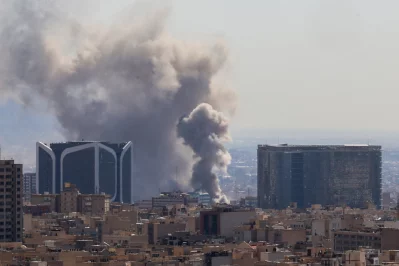
Plumes of smoke were seen rising over parts of Tehran, including areas near government buildings, as emergency responders worked at multiple sites.
Communications disruptions were reported intermittently in the capital, a measure authorities have taken in past crises.
Long lines formed at bakeries and fuel stations as residents sought to stock up on essentials.
Airspace was partially or fully closed in Iran, Iraq, Kuwait, Bahrain, Qatar, the UAE and Israel, prompting widespread flight cancellations and diversions.
Airlines rerouted traffic away from the Gulf and eastern Mediterranean corridors.
Global leaders expressed concern over the rapid escalation. European officials urged restraint and respect for international law, while the United Nations called for an emergency meeting to address the crisis.
Energy markets reacted nervously amid fears that prolonged fighting could threaten shipping routes and oil infrastructure near the Strait of Hormuz, a chokepoint for global energy supplies.
Military analysts say the breadth of Iran’s retaliation — spanning Israel and at least eight Middle Eastern countries hosting US assets — underscores Tehran’s intent to signal that any attack on its leadership would carry regional consequences.
Whether the confrontation settles into a contained exchange or escalates into sustained regional conflict remains unclear.
Much may depend on the scale of further US or Israeli operations and Tehran’s capacity to continue launching coordinated strikes while navigating an unprecedented leadership transition.
For now, from Tehran to Tel Aviv and across the Gulf, the region remains on edge — bracing for what could be the next phase of a conflict that has already redrawn the strategic map of the Middle East.
