


TODAY, as Bangladesh joins the world in observing International Women’s Day, this Women’s Day arrives in the shadow of July 2024 — a political rupture whose meaning, authorship, and outcomes are still being negotiated. Political transitions are often commemorated as moments of progress, yet they also expose how fragile and contingent women’s gains remain. In Bangladesh, women’s revolutionary labour has repeatedly been made hyper-visible in moments of upheaval — circulating through images, slogans, murals, and collective memory — while remaining structurally excluded from the institutions that consolidate power in the aftermath. The post–July 2024 transition has rendered this contradiction unmistakable. As leadership was reconstituted and authority redistributed, men once again occupied the decisive positions through which the future of the state would be defined.
This pattern is not new. The history of women’s political participation in Bangladesh has never become ‘herstory’— that is, a history authored by women as political subjects rather than curated through their symbolic presence. Authorship, in this sense, is not about individual voice alone; it is about access to the sites where political meaning is formalised and preserved. For more than three decades, Bangladesh was governed by women prime ministers, a fact frequently cited as evidence of women’s empowerment. Yet this exceptional visibility coexisted with the systematic marginalisation of women from party hierarchies, parliamentary representation, and decision-making bodies. The elevation of individual women — most often through dynastic or familial legitimacy — did not dismantle the patriarchal architecture of the state; it functioned instead as symbolic cover for its continuity. The persistence of this structure is evident in the most recent national election, where only seven women secured parliamentary seats through direct contestation.
This essay situates that disjuncture within Bangladesh’s longer political history and argues that the present moment represents not a rupture from the past, but a continuation of a gendered mode of governance. Women’s revolutionary labour is repeatedly mobilised during moments of crisis, then absorbed into nationalist and political narratives that celebrate participation while denying authority. What emerges is a recurring political condition: women are central to memory but peripheral to power — revolutionary bodies whose labour is honoured even as their ‘herstories’ are systematically written out. On this International Women’s Day, the question is therefore not whether Bangladeshi women have shaped political change — the historical record leaves little doubt — but whether the transition inaugurated by July 2024 will recognise women as authors of the political future, rather than as symbols of its past.
Revolutionary body as moral capital
THE mobilisation of women during moments of political rupture, followed by their subsequent displacement from settlements, is not a Bangladeshi anomaly. It is a structural feature of nationalist politics. Frantz Fanon observed that colonial liberation movements consistently mobilised women during moments of revolutionary crisis — deploying their participation as evidence of a movement’s popular depth and moral legitimacy — only to reconstitute patriarchal order once independence was secured (Fanon, 1963). The post-independence settlement in
Algeria did not reward women’s revolutionary labour with political authority; it absorbed that labour into a nationalist narrative that celebrated women as symbols of sacrifice while redirecting institutional power to men. The revolution needed women’s bodies to be legible as a people’s uprising rather than a factional seizure. Once legibility was established, those bodies were returned to the domestic order from which they had briefly and necessarily emerged. The events of July 2024 in Bangladesh offer a contemporary illustration of precisely this structure.
Women were at the front lines of the uprising — organising, marching, breaking curfew, making graffiti — their presence giving the movement its moral claim to universality. Yet when the political settlement was assembled, they were nowhere at the table. The July Declaration was drafted without a single woman. The student advisers appointed to the interim government were all men. Party structures reconstituted themselves along familiar lines, reproducing the same gendered hierarchies that had governed Bangladeshi political life prior to the uprising. The transition from rupture to settlement was also a transition from visibility to exclusion.
Partha Chatterjee’s analysis of nationalism and the ‘woman question’ in South Asia provides the ideological architecture through which this return is accomplished (Chatterjee, 1993). Nationalist thought, he argues, resolves the tension between modernisation and cultural authenticity by dividing the world into two domains: an outer domain — the political, the institutional, the properly public — and an inner domain — the spiritual, the familial, and the custodian of authentic identity. Women are assigned to the inner domain. Their elevation as symbols of the nation’s moral purity is precisely what disqualifies them from the outer domain of political authority. Symbolic centrality and political marginality are not contradictory; they are complementary. The woman who embodies the nation cannot govern it simultaneously. This logic is operating in post-July Bangladesh with remarkable explicitness. Women’s participation in the uprising has been extensively commemorated — in murals across Dhaka, in political speeches, and in the visual iconography of the new political moment. That commemorative labour is doing ideological work. It absorbs women’s revolutionary agency into a nationalist narrative of collective sacrifice, fixing them as symbols of the uprising’s moral legitimacy, and in doing so, quietly forecloses the question of their institutional authority. To be the conscience of the revolution is precisely not to be its legislator.
Silvia Federici adds a political-economic dimension to this mechanism. In moments of acute political crisis, women’s bodies and labour function as a ‘common’ — a resource accumulated and deployed collectively, outside the ordinary circuits of political exchange, available to the movement without negotiation or reciprocity (Federici, 2004). Women filled the streets in July 2024 because they recognised the political necessity of the moment and acted upon it as revolutionary subjects — not as invited participants, nor as supplements to a movement. But the commons, as Federici insists, is always subject to enclosure — re-privatised once the crisis has passed, returned to the structures of accumulation from which it was briefly freed. In post-July Bangladesh, the enclosure has been swift and thorough. The Women’s Affairs Reform Commission, which had recommended criminalising marital rape, equal inheritance rights, and equal parental authority — the minimum institutional conditions for women’s political subjecthood — was sidelined within months of its formation. Women constituted less than five per cent of candidates in the February 2026 elections. Party nominations did not signal a redistribution of power; instead, women were overwhelmingly relegated to symbolic or electorally non-competitive candidacies. This is how the commons of women’s revolutionary labour gets enclosed. The symbolic and the substantive are not in tension here. They are in collusion.
Discursive war: delegitimisation of feminist demands
THE exclusion of women from Bangladesh’s political transition is not accomplished through force alone. It is accomplished discursively — through the systemic delegitimisation of feminist demands before they can be entertained as political claims. When the Women’s Affairs Reform Commission recommended criminalising marital rape, equal inheritance rights, and equal parental authority, the response was not a counterargument. It was what Stuart Hall calls ‘articulation’ (Hall, 1980, 1986); these demands were linked, in rapid succession, to a chain of threatening signifiers — Western imposition, secular aggression, and political provocation framed as continuity with the prior regime. In May 2025, almost twenty thousand Hefazat supporters marched. The interim government quietly shelved the recommendations. No substantive debate was necessary because the demands had already been discursively neutralised — not even refuted, clearly disqualified.
Antonio Gramsci (1971) would characterise this as a war of position: a patient, cumulative struggle over the cultural and ideological terrain that precedes and enables formal political power. The Islamist-conservative bloc is not merely reacting to feminist claims; it is consolidating hegemony by shaping the boundaries of what can be said, what counts as authentic, and who counts as a legitimate political subject. In this context, gender equality is recast as the key site through which authority, legitimacy, and the moral boundaries of the state are established. By framing feminist claims as alien or threatening, the bloc preemptively secures ideological dominance over the post-July state. Judith Butler (2015) situates this dynamic in a transnational context, documenting how the spectre of ‘gender ideology’ is invoked across widely divergent political landscapes — from Hungary to Brazil to India — to consolidate conservative and nationalist power. Bangladesh’s post-July moment is a local instantiation of this broader pattern, in which feminist demands are treated not as propositions for negotiation but as signs of cultural and political subversion.
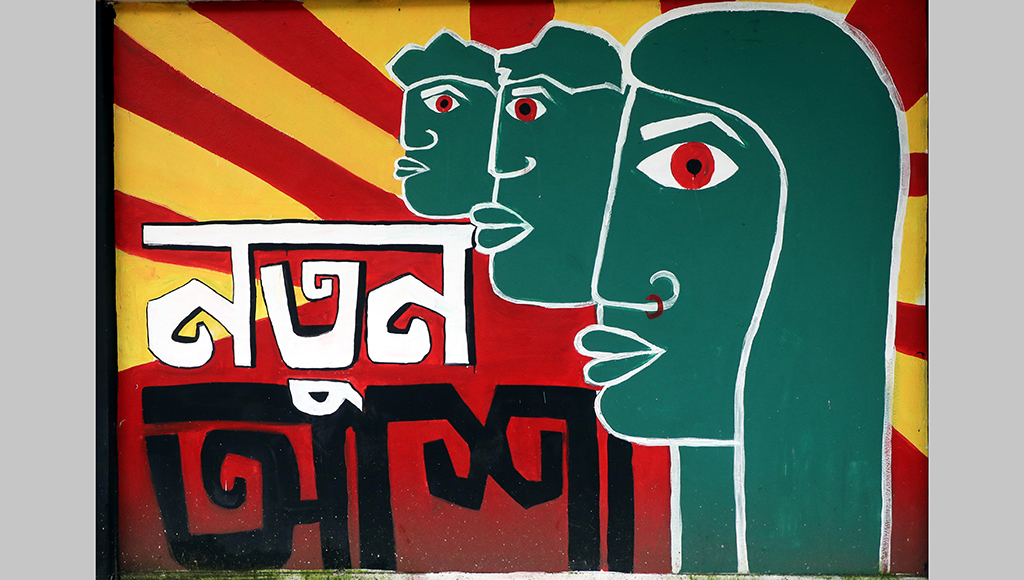 A graffito painted on a wall in Dhaka during the July uprising reads, ‘New hope’. — New Age/Sony Ramani
Chandra Talpade Mohanty (2003) identifies a further dimension of this dynamic. Western feminist frameworks, however well-intentioned, can be weaponised by nationalist and Islamist actors to dismiss any gender rights claim as cultural imperialism. Bangladeshi feminists are caught in a double bind — invoking international human rights frameworks risks delegitimisation as Western proxies, while retreating to locally grounded language leaves them isolated and under-resourced. The discursive architecture of the war of position is structured to foreclose both strategies, and Mohanty argues that what is required is a feminist politics attentive to local specificity yet connected to transnational solidarity, one that refuses both the universalism that erases context and the particularism that abandons solidarity.
The double pincer
BANGLADESH’S current conjuncture is not a single transition but two, unfolding simultaneously in contradictory directions. There is a democratic-institutional transition — constitutional reform, new electoral rules, anti-corruption commissions, and the aspiration toward a more accountable state. Running alongside it is a religious-cultural reconfiguration — the rehabilitation of Islamist parties, the rollback of secular legal reforms, and the reassertion of patriarchal family law as the purported authentic core of Bengali-Muslim identity. Women are caught in a pincer between these two processes, excluded by both in structurally distinct yet mutually reinforcing ways.
The democratic transition has delivered what Hanna Pitkin distinguishes as symbolic rather than substantive representation. Symbolic representation is the presence of women as signs of inclusion; substantive representation is the exercise of authority on behalf of women’s interests (Pitkin, 1967). Bangladesh’s three decades of women prime ministers represent an extreme case of symbolic representation unaccompanied by substantive transformation. The visible female at the apex functioned as an alibi — ‘Bangladesh already had women PMs’ became the answer to every structural question about women’s absence from party hierarchies, local government, and legislative drafting. The post-July transition has reproduced this alibi in a new register. Women’s revolutionary presence in July stands in for their political absence in the aftermath. Naila Kabeer’s (2000) foundational analysis of gender and citizenship in Bangladesh demonstrated that women’s extraordinary economic incorporation — millions of women in the garment sector constituting the foundation of Bangladesh’s development model — was never converted into political power or civic recognition. Women were productive subjects but not political subjects; their labour was essential to the national economy while their authority remained inadmissible in the national polity. The post-July transition has not altered this structure. Applying Nancy Fraser’s (1997) triad of redistribution, recognition, and representation as a diagnostic, Bangladeshi women are failing on all three axes simultaneously. Economic redistribution remains structured by gendered labour hierarchies, cultural recognition is actively constrained by the religious-cultural reconfiguration, and political representation is structurally blocked by the institutional settlement. What is publicly framed as a moment of national renewal is, from the standpoint of Bangladeshi women, a moment of compounded dispossession.
Women do not enter revolutionary moments as free agents. They enter, as Deniz Kandiyoti (1988) argues, as bargainers — negotiating within patriarchal constraints for the best available terms, offering labour and loyalty in exchange for incremental improvements in position. The bargain of July 2024 — women’s bodies in the streets, their moral authority lent to the uprising — has been renegotiated entirely on men’s terms in the aftermath. The terms of the new political contract are being drafted without women at the table. This is not a failure of the transition; it is, structurally, one of its products.
Archive without women
THE writing of political history is never innocent. As Joan Wallach Scott argues, gender is a primary way of signifying relations of power, and its inscription — or erasure — from historical narrative determines who counts as a political agent, whose sacrifices are legible as founding acts, and whose presence is reduced to background colour (Scott, 1988). The history of July 2024 is already acquiring its dominant shape — a story of courageous young men who confronted a dictatorship. The women who broke curfew at midnight, who organised supply chains for protesters, who held the streets when the men retreated — they are becoming a footnote.
This is the structure of all national liberation histories, and Bangladesh has lived it before. Women’s mass participation in 1971 — including the estimated two hundred thousand women who survived sexual violence deployed as a weapon of genocide — was absorbed into the national narrative as victimhood and sacrifice, then gradually evacuated from the political account of what independence meant and who built it. The canonical freedom fighters were men. The birangona — the women of the war — were honoured and then forgotten, their experiences managed as wounds to national honour rather than as evidence of women’s political agency. The history of July 2024 is being made, and it is being made by men. Bangladesh has Beershreshthas — all male — but ‘herstory’ carries no equivalent national honour.
Nira Yuval-Davis (1997) provides the theoretical framework for understanding why this erasure is not accidental. Women function in nationalist projects in three simultaneous registers: as biological reproducers of the national collectivity, as cultural transmitters of national identity, and as symbolic markers of the nation’s honour and boundaries. All three functions are being intensively activated in post-July Bangladesh. Women are needed as mothers of the new nation, as carriers of authentic Bengali-Muslim identity, as the moral boundary that defines the community against its others. What women are not permitted to be, in this nationalist imaginary, are authors — drafters of constitutions, framers of law, architects of the settlement. The nation needs women’s bodies. It does not need their authority.
The task ahead
THE exclusion of women from Bangladesh’s political settlement is not an oversight that goodwill can correct. As Iris Marion Young reminds us, exclusion is structural, not accidental, and structural injustice requires structural transformation (Young, 1990). It is the institutionalised reproduction of patriarchal networks — from party hierarchies to student organisations — that renders women absent from authority. Addressing this requires transformation of those structures, not mere inclusion of individual women. Joan C Tronto (2013) further emphasises that constitutional reform cannot be abstracted from care and social reproduction; leaving family law, inheritance, and protection against marital violence outside the political frame perpetuates gendered hierarchies. Political architecture alone, without attention to these foundational structures, cannot generate substantive equality.
This structural transformation, moreover, cannot be pursued in isolation from the cultural contestation that surrounds it. The Islamist-conservative bloc is not merely blocking women’s institutional inclusion — it is actively redefining the terms of women’s political subjecthood itself, narrowing what can be demanded, said, or imagined within the post-July settlement. Bangladeshi women are therefore required to fight on two fronts simultaneously: against the patriarchal architecture of formal political institutions, and against the discursive war that delegitimises their demands before they reach those institutions. This is the specific and compounded difficulty of Bangladesh’s present political moment. Whether the transition inaugurated by July 2024 will recognise women as authors of the political future, rather than as symbols of its past, remains the defining question of this moment — and the answer, so far, has not been encouraging.
Tina Nandi is an educator, researcher and translator.
