


The decline in breastfeeding in recent years has been linked to growing malnutrition among children and the lack of antibodies among infants below vaccination age, which experts have blamed for high measles infections and deaths during the ongoing outbreak of the highly contagious disease.
The Directorate General of Health Services reported that at least six children died and 1,517 others were infected with measles or symptoms in the past 24 hours until 8:00am on Sunday, taking the total deaths to 459 and infections to 65,613 since March 15.
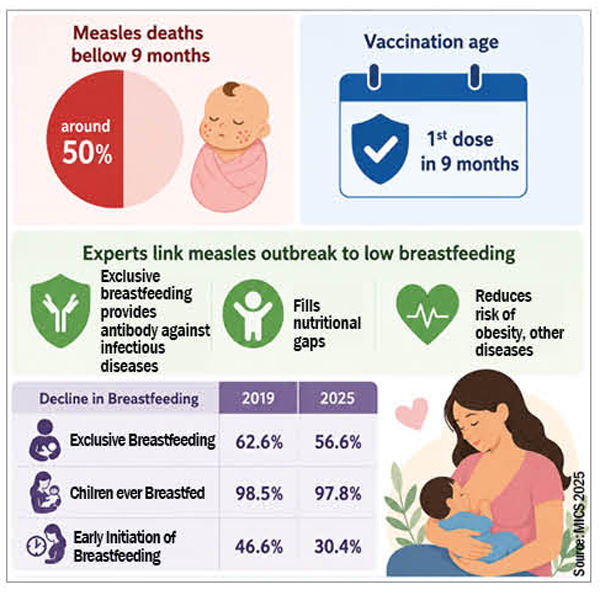
Health experts have said that many children who died from measles were below nine months of age — the age when children become eligible for routine measles vaccination — as infants are medically expected to receive protective antibodies from their mothers through breastfeeding during the early months of life.
Government data show that almost half of the 60 confirmed measles deaths involved children below nine months of age, meaning they were not yet eligible for routine measles vaccination.
The government administers the first dose of the measles-rubella vaccine at nine months and the second dose at 15 months.
Among the 60 confirmed deaths recorded in 21 districts, 29 children died before reaching nine months of age, including 15 who were six months old or younger.
They say that the falling breastfeeding rate, coupled with gaps in measles vaccination and delayed Vitamin A supplementation, made children more vulnerable to measles because of poor nutrition and reduced immunity.
Former vice-chancellor of Bangladesh Medical University and virologist Professor Nazrul Islam said that the vaccination schedule had been designed considering that breastfed children would receive antibodies from their mothers.
‘If a child is deprived of breastfeeding, it means the child is deprived not only of antibodies but also of nutrition and many other health benefits,’ he said.
According to the preliminary report of the Bangladesh Multiple Indicator Cluster Survey 2025, jointly conducted by the Bangladesh Bureau of Statistics and the UNICEF and published in November 2025, all forms of breastfeeding declined in Bangladesh.
The rate of exclusive breastfeeding among infants under six months declined from 62.6 per cent in 2019 to 56.6 per cent in 2025.
The percentage of children ever breastfed fell from 98.5 per cent in 2019 to 97.8 per cent in 2025.
Early initiation of breastfeeding — defined as putting newborns to the breast within one hour of birth — declined sharply from 46.6 per cent in 2019 to 30.4 per cent in 2025.
UNICEF says that the decline in early initiation of breastfeeding was associated with poor health outcomes and the high rate of unnecessary caesarean deliveries.
It states that an alarming number of women in Bangladesh were giving birth through caesarean section. In urban areas, 56 per cent of women deliver through C-section, while in rural areas the rate stands at around 50 per cent.
UNICEF stresses the need to improve awareness among women and healthcare professionals about the importance of breastfeeding.
Health experts observe that breastfeeding declined over the years because of weak enforcement of the Breast-Milk Substitutes (BMS) Act, 2013, aggressive marketing by formula milk companies, the rising rate of caesarean deliveries, inadequate facilities for mothers, insufficient breastfeeding promotion campaigns and changing lifestyles among mother.
Pediatric specialist Dr ARM Sakhawat Hossain Khan said that breastfeeding grows antibody as well as immunity of children to fight against not only measles but also other infectious diseases.
Breastfeeding provides complete nutrition for infants during the first six months of life and protects them from diarrhoea, pneumonia, measles and other childhood illnesses. It also reduces the risk of obesity and other diseases later in life.
Exclusive breastfeeding means feeding infants only breast milk without water, liquids or solid food, except oral rehydration solution, prescribed vitamins or medicines.
Sakhawat Hossain said that early vaccination—before nine month—might destroy other antibodies the children received from mothers.
‘Artificial feeding may give iron, vitamin or minerals, but not antibody,’ he added.
Bangladesh Breastfeeding Foundation chairman Dr Swapan Kumar Roy said that breastfeeding promotion activities weakened after 2019 because the issue no longer received adequate funding under government operational plans.
He said that while campaigns promoting breastfeeding declined, marketing by baby food companies spread almost unchecked because of weak enforcement of the BMS Act 2013.
He also said that many mothers were now engaged in outdoor professions while workplaces and public facilities remained unfriendly to breastfeeding.
As per a joint WHO-UNICEF report published in 2022, nearly 60 per cent of mothers in Bangladesh were recommended formula milk products by health professionals.
The report says that although 98 per cent of pregnant women expressed a strong desire to breastfeed, only 65 per cent continued exclusive breastfeeding after childbirth.
Public health campaigners allege that breast milk substitute companies continued aggressive marketing in violation of the law while authorities failed to monitor the practices properly.
They say that companies are openly promoting their products in healthcare facilities and on social media despite legal restrictions.
The Institute of Public Health Nutrition is responsible for monitoring violations of the law.
However, IPHN director Dr Mohammed Eunus Ali denied that companies were campaigning against breastfeeding or that doctors were prescribing substitute food products.
‘We did not take punitive action against any BMS-producing company in the last two years because we did not receive any complaints,’ he said.
The Bangladesh National Nutrition Council, a high-powered body chaired by the prime minister and responsible for setting national nutrition policies, also remained largely inactive over the years.
According to official rules, the council is supposed to hold meetings every six months. However, its last meeting was held in 2017, while the previous meeting took place in 1997.
BNNC director general Dr Md Rizwanur Rahman said that an initiative had been taken last year to organise a meeting but it could not be held.
‘BNNC is not practically a functional organisation,’ he admitted and said that the reasons behind the decline in breastfeeding needed to be investigated.
Officials say that the council remained ineffective because of manpower shortages, legal complications and lack of political attention.
In 2023, the High Court, responding to a writ petition filed in 2019, directed the authorities to establish breastfeeding corners in all public places, offices, shopping malls, airports, bus terminals, launch terminals and railway stations.
However, no functional breastfeeding corner accessible to common mothers could be found in major terminals, shopping malls and even at airports.
Experts also linked the decline in breastfeeding with the sharp rise in caesarean deliveries.
According to the Bangladesh Demographic and Health Survey, the C-section rate rose to 45 per cent in 2022 from 34 per cent in 2018, 24 per cent in 2014 and 18 per cent in 2011.
The World Health Organization recommends that national caesarean section rates should remain between 10 and 15 per cent.
Experts said that mothers who undergo caesarean delivery often struggle to initiate breastfeeding because of pain, delayed recovery and lack of post-surgery support.
As a result, many families turn to formula milk immediately after birth and continue relying on it later.
