


Locals call it the jewellery village. For Bhakurta village of Savar Upazila, jewellery-making is more than a trade; it is a family legacy slowly being pushed to the edge. Generations of artisans have shaped gold and silver, and later copper and brass, into bangles, rings, chains and necklaces. But today, low wages, rising raw material costs and the growing dominance of machine-made jewellery are making it harder for them to survive. Behind the familiar rows of jewellery shops lies a community fighting to keep an old craft and its livelihood from disappearing.
From gold to copper
According to residents, artisans here once made gold jewellery. It has been a family profession for many villagers. The father worked, while the son sat beside him and learned the craft.
From childhood, they became familiar with metal, and gradually developed the skills of their hands.
But as the price of gold rose, the work became less accessible.
Many artisans and traders gradually shifted towards silver jewellery. At one point, silver became an important material in Bhakurta'sjewellery industry. But as the price of silver also increased, that market began to shrink. Many then moved towards making jewellery from relatively cheaper metals such as copper and brass. According to locals, over the past 15 to 20 years, copper and brass jewellery have become a major part of the industry in this area.
How jewellery travelled from the craftsman's Hands, to the city
In the hands of an experienced craftsman, a piece of copper or brass gradually takes the shape of jewellery. Sometimes the metal is given a specific shape, sometimes small pieces are made and joined together.
In some jewellery, artisans must create intricate designs by hand, often through meenakari.
A key aspect of Bhakurta's industry is that artisans mainly work on the jewellery's design, patterns, and structure. Many of the pieces then go to different workshops and major markets across the country.
There, after colouring, polishing and finishing, the jewellery gets its final form.
Handcrafted copper necklace showing intricate traditional artisan design. Photo by Ashikur RahmanLegacy: From father to son
Forty-one-year-old Swapan Sarkar has been involved in jewellery-making for more than two decades. His father was also a jewellery maker. Swapan learned the art from his father in his childhood.
At the beginning of his career, Swapan made silver jewellery.
According to him, he once earned wages of Tk 700 to Tk 800 a day for silver work. Now, he makes copper jewellery. He says he earns around Tk 450 a day for copper work and around Tk 500 for silver work. However, he says silver work requires more labour.
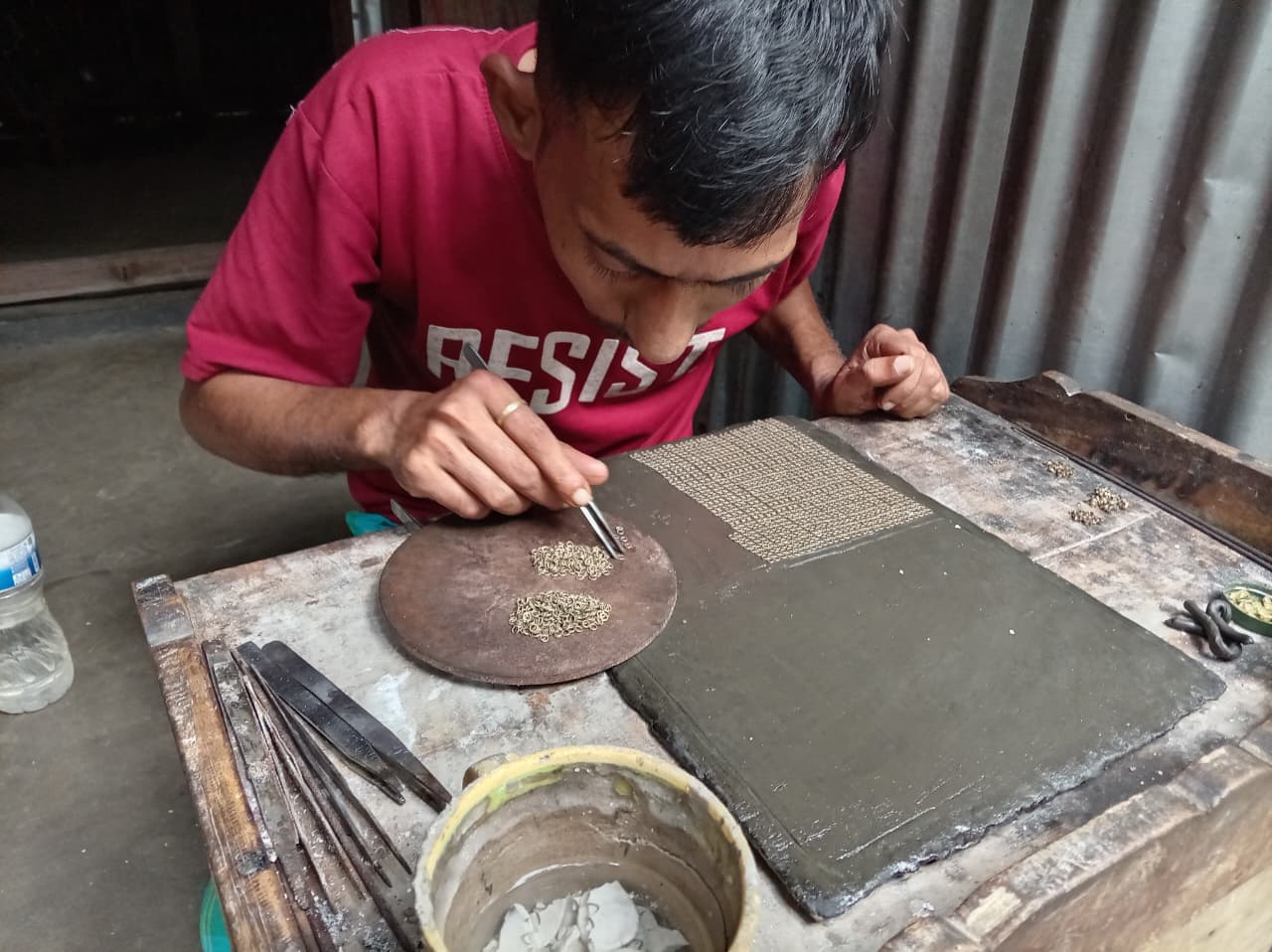
Swapan's words reveal another reality. Although the cost of living has increased, artisans' income has not risen at the same rate.
"The prices of raw materials and various other things have increased over the past four to five years. But the payment for the work has not increased accordingly," he says.
Contribution of women
Women, alongside men, are also involved in jewellery-making in Bhakurta. Many women make different parts of jewellery while working from home. Because the work lets them earn from home alongside household responsibilities, the profession is important to them.
However, they also complain about wages. Those involved in the work say that although the cost of raw materials and living expenses has increased, the value of their labour has not increased in line with it.
When a piece of jewellery reaches a shop in the city and catches a customer's attention, its beauty comes to the forefront. But the labour of the craftsman behind that beauty generally remains invisible.
Fewer shops exist
According to Bhakurta Bazar trader Md Badsha, there used to be 18 shops in his area. At present, around 12 shops remain open. Local traders say sales are no longer what they once were.
At the same time, raw material prices have increased, and new forms of competition have entered the market. Machine-made jewellery is one of the biggest challenges.
Various types of machine-made jewellery come into the market from India and China. Machines can produce large quantities of products quickly. Machines can also reproduce the same designs quickly.
On the other hand, a handmade piece of jewellery requires an artisan's time. Each design involves different kinds of labour and skill. As a result, handmade jewellery now competes in a market where production speed is much higher.
Why the Younger Generation is Losing Interest
This may be the biggest crisis facing Bhakurta's jewellery industry today. The question is how many of the younger generation want to remain in this profession.
It takes time for a new artisan to become skilled. One has to sit beside an experienced artisan and learn the craft for a long period.
Mistakes happen, and then one has to learn again. Hand skills develop after years of practice. But if the financial value of that skill is comparatively low, it is not unusual for the younger generation to turn towards other professions.
Statements from local representatives also reflect this reality: many are leaving the profession because of low wages.
In this way, what may gradually disappear is not only a source of employment but also a traditional body of craftsmanship and knowledge.
Around 58,000 people live in Bhakurta Union, according to a local representative.
Md Zakir Hossain, panel chairman of the Union Parishad, said a significant portion of the local population is involved in jewellery-making in one way or another.
Some are artisans, some are traders, while others are involved at the wholesale level. As a result, the jewellery industry has created local economic activity.
If this industry contracts, the impact will not fall only on the artisans. It will also affect the families, shops and local businesses connected to it.
Will the Jewellery village survive?
Locals are demanding incentives and government support to keep Bhakurta's jewellery industry alive.
At the same time, the industry needs fair wages, easy access to raw materials, and market expansion. Simply continuing to work in the old ways may not be enough to sustain the industry.
Opportunities include new designs, modern marketing, online markets, and access to potential markets outside the country.
Modern technology can also be used where necessary, rather than being viewed only as a competitor. However, the skills and livelihoods of the artisans must remain at the centre of these initiatives because Bhakurta's greatest asset is not its shops, but the hands of its craftsmen.
From gold to silver, and from silver to copper and brass, Bhakurta's jewellery industry has changed repeatedly over time. Each time, the artisans have adapted themselves to the realities of the market.
Now, the biggest change they face is not in the metal, but in the profession itself. If the profession passed from father to son, from one generation to another, it is no longer sustainable for the younger generation. One day Bhakurta's identity as a jewellery village may survive only in history. The market will remain, the name will remain, and the stories will remain.
But perhaps the hands of the craftsmen who turned a piece of metal into jewellery will no longer be there. Or it will survive as it has so far, changing its metal or maybe its style.
