


The 13th Jatiya Sangsad began its maiden session on Thursday with chaotic scenes as opposition lawmakers protested inside the chamber over allowing the president to address the House, eventually staging a walkout.
- Hafiz Uddin elected speaker, Kaiser Kamal dy speaker
- 133 ordinances tabled
- PM urges constructive debate
- Opposition leader for end to negative precedents
- New parliamentary committees formed
- Speaker panel formed
The first sitting of the new parliament took place about 20 months after the final session of the 12th Jatiya Sangsad, which had been prorogued on July 3, 2024.
Following the overthrow of the Awami League-led government through a student-led mass uprising on August 5, 2024, president Mohammed Shahabuddin dissolved the 12th Jatiya Sangsad the following day, on August 6.
The inaugural sitting of the new parliament began at 11:00am, with newly elected members exchanging greetings among themselves ahead of the beginning of proceedings.
Initially, the opposition members participated cordially in electing the new speaker and deputy speakers, adopting the condolence motion, tabling 133 ordinances from the interim government, and nominating a new panel to preside over the JS sessions in the absence of the speaker.
However, the atmosphere in the House turned tense during the president’s address.
At the sitting, lawmaker for Bhola-3 Hafiz Uddin Ahmed Bir Bikram was elected speaker, while MP for Netrakona-1 Kaiser Kamal was unanimously elected deputy speaker.
Law justice and parliamentary affairs minister Md Asaduzzaman placed 133 ordinances issued during the immediate past interim government before the House on the opening day of the session.
In accordance with Article 93(2) of the constitution, the minister placed the ordinances for discussion on them.
After being tabled in parliament, the respective ministries will take steps to convert them into laws, while the House will decide whether to ratify them in line with parliamentary practice.
The sitting began with senior MP Khandaker
Mosharraf Hossain presiding over the House as both the speaker and deputy speaker of the previous parliament were absent.
Prime Minister Tarique Rahman proposed Mosharraf’s name to chair the sitting, which was supported by MP Fakhrul Islam Alamgir.
Mosharraf later announced the election of the Speaker. Chief Whip Nurul Islam proposed the name of Hafiz Uddin Ahmed for the post, which was supported by MP Rakibul Islam.
For the post of deputy speaker, the MP for Natore-2 Ruhul Quddus Talukdar Dulu proposed the name of Kaiser Kamal, which was seconded by the MP for Lakshmipur-4 ABM Ashraf Uddin Nizam.
Newly elected speaker Hafiz Uddin Ahmed and deputy speaker Kaiser Kamal later took oath at the president’s chamber at the Jatiya Sangsad, administered by the president.
A five-member panel of chairpersons was also nominated to preside over sittings in the absence of the speaker and deputy speaker.
Announcing the panel during the sitting, the speaker said that the nominated members were BNP lawmakers Mirza Abbas Uddin Ahmed for Dhaka-8, Gayeshwar Chandra Roy for Dhaka-2, Abdul Moyeen Khan for Narsingdi-1, Mohammad Monirul Haque Chowdhury for Cumilla-6, and Jamaat-e-Islami MP ATM Azharul Islam for Rangpur-2.
Addressing the session, prime minister Tarique Rahman said that the newly formed parliament belonged to the people of Bangladesh, adding that citizens were looking towards it with expectations.
He said that the speaker was no longer affiliated with any political party but was the guardian of the entire Jatiya Sangsad, stressing the need to make the House meaningful in the interest of the country and its people.
The prime minister said that for more than one and a half decades the democratic political rights of the people had been curtailed and the Jatiya Sangsad had been turned into a club of those who deprived citizens of their rights.
He said that the current parliament consisted of representatives directly elected by the people’s vote.
Tarique also said that the government did not want opposition merely for the sake of opposition but hoped that it would make the House vibrant through logical arguments and constructive debate, noting that the role of the speaker was crucial in this regard.
Opposition leader Shafiqur Rahman congratulated the newly elected speaker and deputy speaker, hoping that the Jatiya Sangsad would avoid the negative precedents of the past.
He said that Bangladesh had experienced several parliaments since independence, but the legislature and parliamentary politics had functioned effectively only for limited periods.
According to him, people benefited when parliament worked properly, but for much of the time it remained in the grip of authoritarianism.
Shafiqur hoped that the negative practices of the past would not be repeated and urged that parliament not to become a place for character assassination.
He also assured the speaker of the opposition’s cooperation in running the House effectively.
Referring to the political change brought about by the July movement, he said the present parliament had emerged after the July bloodshed and carried the expectations from that movement.
The opposition leader said that the central demand in the July uprising was for justice and hoped that the Jatiya Sangsad would help end injustice, irregularities, and wrongdoing in political, economic, and cultural spheres.
The House also adopted a condolence motion expressing grief over the deaths of former prime minister and BNP chairperson Khaleda Zia and several other national and international personalities.
Speaker Hafiz Uddin Ahmed placed the motion at the beginning of the sitting, stating that the nation lost Khaleda Zia on December 30, 2025.
A three-time prime minister and former opposition leader in parliament, she was also the second female prime minister in the Muslim world, and her contribution to safeguarding democracy in Bangladesh was described as significant.
The Jatiya Sangsad also expressed condolences over the deaths of several international figures, including former Indian prime minister Manmohan Singh, head of the Catholic Church Pope Francis, and Iran’s Supreme Leader Ali Khamenei.
The House further introduced condolence motions over the deaths of 31 former Members of Parliament, including former president AQM Badruddoza Chowdhury.
Among the notable figures mentioned were former deputy leader of parliament Matia Chowdhury, retired Major General and the first Chief of Army Staff KM Shafiullah, former minister Abdullah Al Noman, Mostafa Mohsin Montu, Abdul Karim Khandaker, and Ramesh Chandra Sen.
The condolence message also referred to an army officer killed during the Bangladesh Rifles Mutiny. Following the presentation of the motion, Members of Parliament took part in discussions.
Meanwhile, five committees were formed during the first sitting of the 13th Sangsad.
The committees include the Business Advisory Committee, the House Committee, the Special Committee, the Standing Committee on Privileges, and the Committee on Private Members’ Bills and Resolutions.
Speaker Hafiz Uddin Ahmed constituted the Business Advisory Committee and the House Committee, while Chief Whip Nurul Islam proposed the remaining three committees, which were later approved by the House through voice vote.
The opposition alliance in the 13th JS, led by Bangladesh Jamaat-e-Islami, staged a walkout from the sitting in protest against the president’s address.
Opposition leader Shafiqur Rahman, deputy opposition leader Syed Abdullah Mohammad Taher, and opposition whip Nahid Islam led fellow lawmakers during the protest.
The event unfolded when president Mohammed Shahabuddin entered the chamber to deliver his speech.
Moments before his arrival at 3:34pm, opposition MPs displayed placards carrying anti-fascism messages and chanted slogans against the president.
When the president entered the House, treasury bench members stood up in his honour while opposition members remained seated. As the national anthem was played, treasury bench members, including BNP secretary general Mirza Fakhrul Islam Alamgir, gestured to opposition lawmakers to stand up during the anthem.
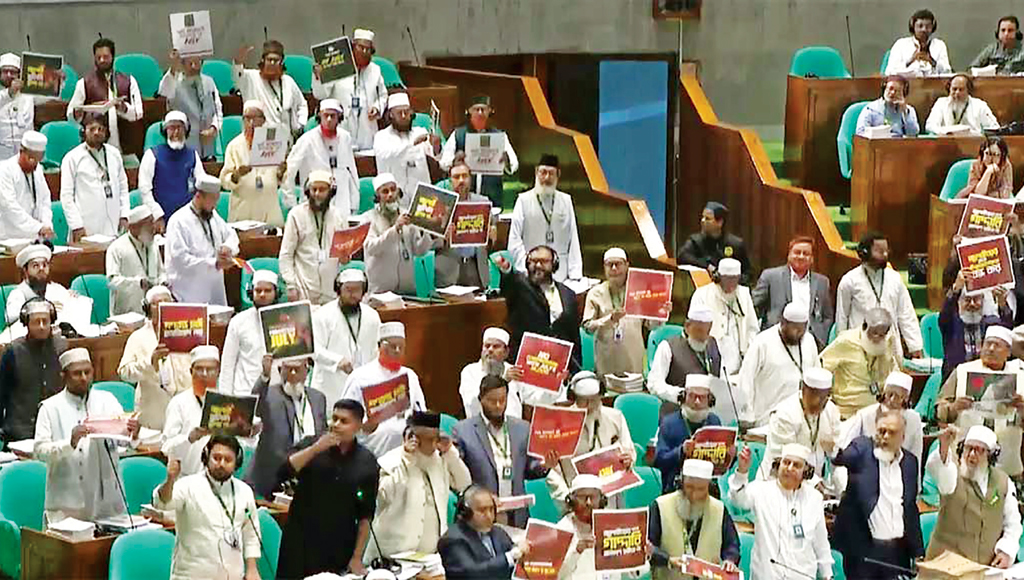 Opposition lawmakers stage demonstration inside the parliament and display red cards, inscribing ‘No betrayal with July’, as president Shahabuddin begins delivering his speech, before the opposition lawmakers walk out of the House on Thursday, the first day of the new session of the 13th parliament. — Star Mail photo
Despite the protest from opposition and the subsequent walkout, the president began his address at 3:41pm.
When speaker Hafiz Uddin Ahmed invited the president to deliver his speech, Nahid Islam, a lawmaker from the National Citizen Party, sought the speaker’s attention to speak.
As he was not given the microphone, he stood up and shouted ‘killer in the parliament’, repeatedly voicing his objections.
Opposition lawmakers then rose from their seats holding placards with various messages and continued their protest.
The speaker urged the opposition members to maintain order, but they continued their demonstration.
Later, NCP lawmaker Hasnat Abdullah chanted slogans calling for a boycott of the president.
Amid the commotion, the president arrived beside the speaker’s chair and was requested to take his seat while the protest continued.
As the president stood to begin his speech, opposition leader Shafiqur Rahman told him that as president he was supposed to act as the guardian of the state but had failed to fulfil that responsibility and had instead sided with authoritarianism.
Other opposition lawmakers shouted slogans such as ‘Get out’.
For a brief moment, the president remained silent at the podium while opposition members continued chanting slogans warning against supporters of authoritarian rule and declaring that authoritarianism and democracy could not coexist.
He then proceeded with his address.
During the speech, opposition lawmakers also mocked treasury bench members, chanting ‘shame, shame’ while looking towards them.
The president concluded his address at around 4:30 pm.
Shortly afterwards, the speaker adjourned the session until 11:00 am on 15 March.
Opposition members did not return to the House for the remainder of the sitting.
