


Finance Adviser Dr Salehuddin Ahmed on Saturday said lowering interest rates was a complex and delicate task, warning that policy missteps could trigger unintended consequences across the economy.
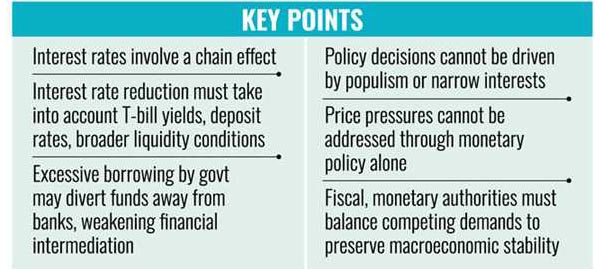
"Interest rates involve a chain effect. If we tighten one part, another one may bubble up. It (lowering interest rates) is not an easy task," he said while speaking at the launch of the seventh edition of the Banking Almanac, an annual reference publication on the country's banking sector, at the CIRDAP International Conference Centre in the capital.
The event was presided over by Dr Hossain Zillur Rahman, acting chairman of the Banking Almanac's board of editors and a former adviser to the past caretaker government.
Dr Ahmed's remarks came amid growing criticism from business groups over the prolonged period of high borrowing costs.
He said any reduction in interest rates must take into account treasury bill yields, deposit rates, and broader liquidity conditions.
Dr Ahmed, also a former central bank governor, said treasury bill rates had declined in recent months, which caused the reference or benchmark to determine the interest rates.
"Maintaining balance is essential. Excessive borrowing by the government could divert funds away from banks, weakening financial intermediation."
On inflation, the finance adviser said price pressures remained a sensitive issue that could not be addressed through the monetary policy alone.
He stressed the importance of supply-side management, effective market surveillance, and coordination among traders and wholesalers, adding that enforcement actions by themselves were insufficient to curb profiteering or hoarding.
Dr Ahmed said Bangladesh's development had been seen as cumulative, built on sustained efforts over decades.
He also warned that excessive negativity could undermine investors' confidence and harm Bangladesh's international standing.
"Policy decisions cannot be driven by populism or narrow interests," he said, adding that the fiscal and monetary authorities must balance competing demands to preserve macroeconomic stability.
Despite the criticism of the recent policy measures, he said the ongoing reforms were laying the foundation for a more stable and resilient economy.
Dr Ahmed also highlighted the role of financial data and analytical publications in improving transparency and policymaking.
Finance Secretary Dr Md Khairuzzaman Mozumder said the country's financial sector had endured a prolonged period of stress over the past 18 months, but conditions were now improving.
He said there were no longer any significant problems related to letter of credit (L/C) payments, while several troubled banks were showing signs of recovery. Efforts were also underway to repay depositors of the struggling financial institutions, he said.
Nazma Mobarek, secretary of the Financial Institutions Division, said the Banking Almanac was a "statistical handbook" for policymakers, regulators, and researchers, adding that it could serve as an early warning tool for emerging economic risks.
Bangladesh Bank Deputy Governor Nurun Nahar said compiling such a publication was a labour-intensive, research-driven exercise, but one that could help policymakers make more informed decisions in the banking sector. Abdul Hai Sarker, chairman of the Bangladesh Association of Banks (BAB), said decisions on lowering interest rates ultimately rested with the government rather than industry bodies.
He said the Banking Almanac was an important guide for the financial sector and potential investors assessing Bangladesh.
Mohammed Nurul Amin, a member of the Banking Almanac's board of editors and a former chairman of the Association of Bankers Bangladesh, and Md Mahbub ur Rahman, chief executive of HSBC Bangladesh, also addressed the event.
jasimharoon@yahoo.com
