


Fifty-year-old farmer Sudhin Chandra Das cultivated boro paddy on 150 decimals of leased land in Shalla upazila of Sunamganj, part of the country’s haor region, hoping to harvest the crop in late April.
But two spells of excessive rainfall on April 27 and May 2 inundated his fields, destroying the standing boro paddy on three-fourths of his paddy land before he could harvest it.
Sudhin had taken a Tk 50,000 loan from Bangladesh Krishi Bank to cultivate the crop. The disaster left him struggling with debt and uncertainty over repayment.
‘So far, no relief has reached me. I am planning to migrate to another district to work as a labourer as I can’t wait for relief,’ Sudhin told New Age on Wednesday.
Excessive rainfalls between April 26 and May 4 across the haor region before the boro harvest damaged paddy on thousands of hectares and pushed farmers like Sudhin deeper into debt, also raising concerns over rice supply in the days to come.
Another farmer, Bojlu Miah, 50, of Derai upazial in Sunamganj, said that he had borrowed Tk1,00,000 from two banks to grow boro paddy on 360 decimals of land. He said that he could harvest half of the standing crop before the lands were flooded in early May.
The remaining half of the paddy, which he managed to harvest, was damaged and would fetch lower price than the normal.
‘To repay the debt I have incurred, I will have to wait until next year’s harvest comes in. But next year too, I will have to take loans again,’ Bojlu said.
Bangladesh Krishi Bank Sylhet division officials said on Thursday that a total of Tk483.28 crore was disbursed in agricultural loan until May 7, while the outstanding agricultural loan amount stood at Tk 1,435.70 crore.
Agriculture secretary Rafiqul I Mohamed on Wednesday, despite being asked, did not talk about farmers’ debt issue. But he said that the government was preparing a three-tier recovery plan, including bringing the affected farmers under the crop insurance scheme gradually.
‘The immediate step is relief support for farmers,’ he said, adding that the affected farmers would receive cash and food assistance before Eid-ul-Azha in late May.
The relief operation, launched on May 5, was later suspended as authorities began reviewing the list of affected farmers.
‘Research on cold-tolerant and early-harvest boro varieties will also be streamlined so that such varieties can be introduced within the next seven months,’ he added.
Former principal scientific officer of the Bangladesh Rice Research Institute Md Rafiqul Islam said that introducing cold-tolerant and early-harvest boro varieties was crucial for haor farmers.
He, however, expressed doubt about the feasibility of developing a variety combining both traits.
‘Combining cold tolerance with an early harvest variety is difficult. There were experiments in this regard before, but without success,’ he said.
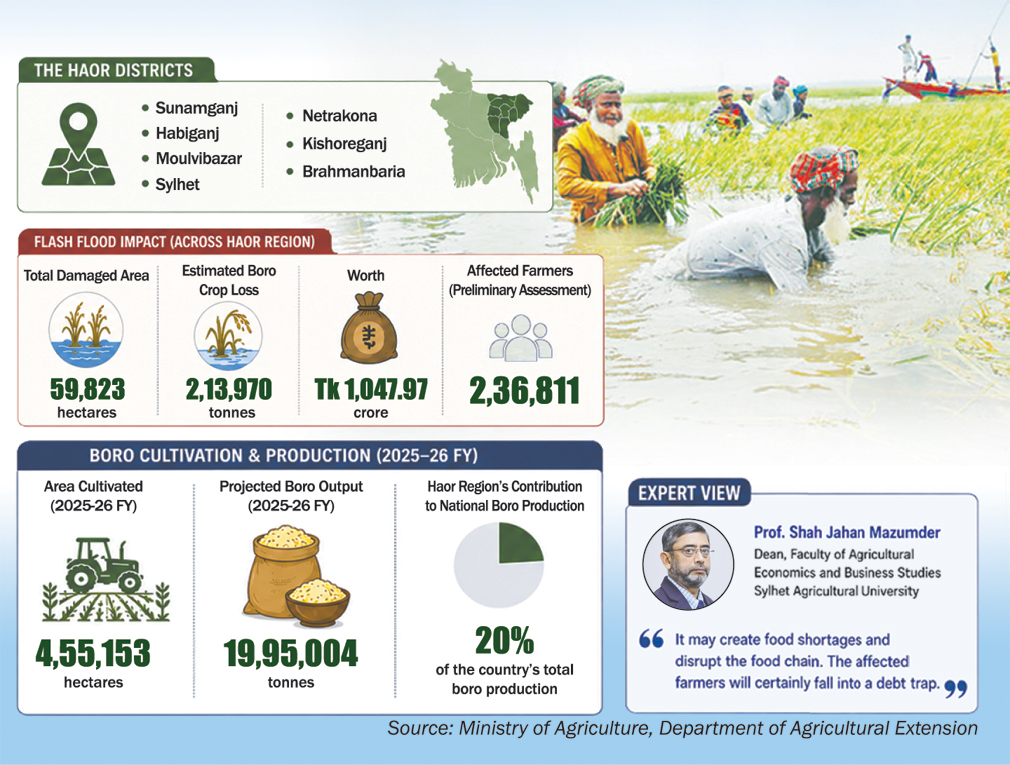
This season, boro paddy was cultivated on 4,55,153 hectares across the haor districts of Sunamganj, Habiganj, Moulvibazar, Sylhet, Netrakona, Kishoreganj, and Brahmanbaria.
The Department of Agricultural Extension had projected 19,95,004 tonnes of boro paddy output from the haor region in the 2025–26 financial year.
According to the DAE Sylhet regional office, standing boro paddy on 30,085 hectares of land in Sunamganj, Habiganj, Moulvibazar and Sylhet were damaged by heavy rainfalls and flash floods caused by upstream hill runoff from across the border.
DAE officials also reported flash flood-induced damage to boro paddy on 16,877 hectares in Netrakona, 12,554 hectares in Kishoreganj and 307 hectares in Brahmanbaria.
The Bangladesh Meteorological Department recorded an average of 603-millimetre rainfall across the Sylhet division in April, more than double the monthly average of 295mm. Nikli, a haor-dominated upazila in Kishoreganj, on April 28 experienced the highest single-day rainfall at 160mm.
Saying that the final assessment of damage and the number of affected farmers was still under process, agriculture ministry senior information officer Mohammad Zakir Hossain said on Wednesday that flash floods over the haor region between April 26 and May 4 might have caused crop losses estimated at 2,13,970 tonnes worth Tk 1,047.97 crore.
The preliminary assessment showed that 2,36,811 farmers in seven haor districts were affected by the floods.
As of May 13, boro harvesting had been completed on 3,87,752 hectares, or 96.80 per cent of the haor land.
‘However, all of the harvested boro paddy would not be processed as rice since some amount of the wet crop is likely to rot,’ said DAE additional deputy director (control room) Muhammud Belayet Hossain.
According to official data, the haor region accounts for about 20 per cent of the country’s total boro paddy output.
Professor Shah Jahan Mazumder, dean of the faculty of agricultural economics and business studies at Sylhet Agricultural University, said that the latest disaster would have a significant economic impact.
‘It may create food shortages and disrupt the country’s food chain. The affected farmers will certainly fall into a debt trap,’ he told New Age on Wednesday.
