


THERE are moments in history when geopolitics ceases to be merely about power and becomes something far more intricate: an unfolding system of interdependence, perception and risk. The current confrontation between the United States and Iran is one such moment. It is not simply a stand-off. It is a game — structured, strategic and dangerously fragile — where movements of fleets and tones of speeches reverberate far beyond the battlefield.
What appears as aggressive rhetoric and military signalling is, in fact, a deep contest shaped by incentives, constraints and expectations. At its core, it is a game of calculated moves and uncertain outcomes, where the greatest danger lies not in intent, but in misinterpretation. A signal meant as deterrence may be read as provocation; restraint may be perceived as weakness. Perception does not merely reflect reality. It reshapes it, altering the payoff structure in real time.
The United States enters with overwhelming military superiority. Iran enters with something less visible but equally potent: geographic leverage. This is not a symmetrical contest. The United States seeks deterrence through dominance; Iran seeks influence through disruption. One projects power; the other manipulates vulnerability. This asymmetry is not a weakness. It is the architecture of the game.
The entire contest converges on a narrow passage: the Strait of Hormuz. Here, geography becomes strategy and strategy becomes global consequence. Roughly one-fifth of the world’s oil supply flows through this corridor, making it the artery of the global economy. It is an economic singularity where a local disturbance can trigger global shock waves. Iran does not need to close the strait. It only needs to make the world believe that it might.
This is not a game either side can truly win. The only stable outcome — mutual restraint — is also the most fragile. Every other combination leads to imbalance and, in the worst case, systemic crisis. In the language of physics, this is a metastable system, appearing stable until a sufficiently large perturbation pushes it into a less desirable state.
A Nash equilibrium here is the fragile point of mutual restraint, where neither side can improve its position by acting alone. Washington must recognise that escalation cannot yield decisive gains without triggering oil shocks and wider conflict. Tehran must recognise that disruption would invite retaliation so severe that any temporary leverage becomes self-defeating.
This equilibrium does not depend on trust. It depends on calculation: cold and disciplined. Each side must view unilateral deviation not as opportunity but as self-inflicted damage. Only then does restraint become rational.
Yet, this equilibrium is inherently unstable. If the United States believes pressure can force submission at acceptable cost, escalation becomes tempting. If Iran believes limited disruption can raise global costs without unbearable retaliation, defection becomes attractive. The equilibrium survives only as long as both sides fear moving first. It is sustained not by harmony, but by symmetry of fear.
The most realistic outcome is, therefore, not stable peace, but calibrated brinkmanship: a tense condition where both sides probe limits yet stop short of catastrophe. This is equilibrium not as rest, but as motion: a dynamic balance sustained through continuous adjustment.
The most powerful weapon in this game is not military force, but uncertainty. Markets react not to confirmed events, but to signals, probabilities and fear. A hint of disruption is enough to raise oil prices, disrupt insurance markets and force governments to reassess vulnerabilities. Iran’s strategy, thus, leverages the psychology of markets rather than the physics of war. Limited action can generate disproportionate global consequences.
There is, in effect, a third player: global markets. They do not choose sides, but they determine outcomes. They amplify signals, price risk and transmit shocks across borders. A localised incident becomes a global economic event. The game is no longer bilateral; it is systemic.
The transmission mechanism is immediate and unforgiving. Even partial disruption raises energy prices, which cascade into transport, manufacturing, agriculture and consumer goods. Inflation rises. Growth slows. The result is stagflation: the most difficult condition for policymakers to manage, where monetary tightening cannot produce oil, and fiscal expansion risks further imbalance.
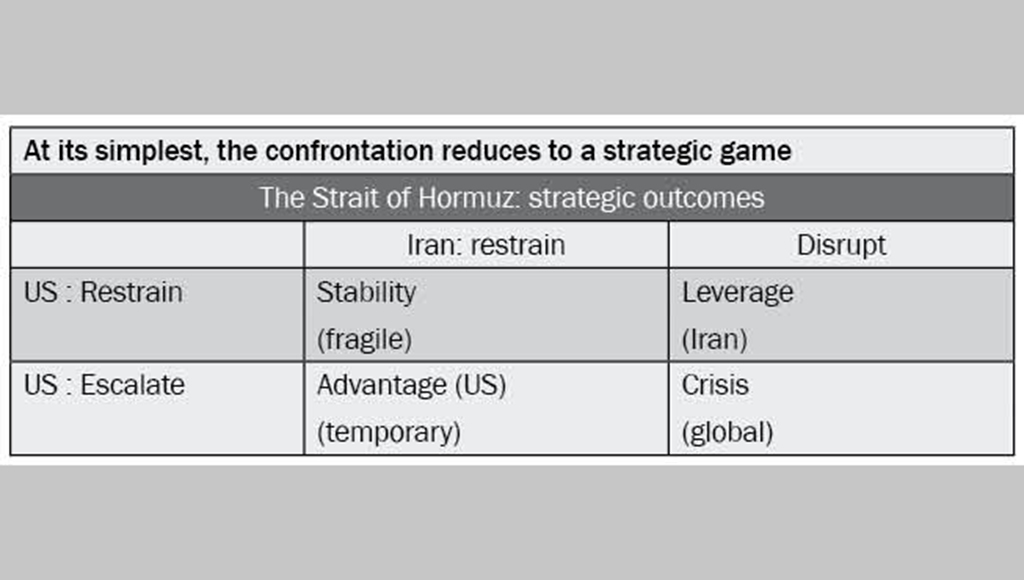
Game theory assumes rational actors. Reality introduces something more dangerous: miscalculation. Signals may be misread, actions over-interpreted, escalation triggered by accident. A naval encounter or misjudged manoeuvre could shift the system from controlled tension to uncontrolled conflict. In such moments, the distinction between the imaginable and the probable collapses.
At that point, the system ceases to be strategic and becomes chaotic, not metaphorically, but in the precise sense of non-linear dynamics, where small deviations produce disproportionately large outcomes.
What makes this confrontation uniquely dangerous is its reach. Decisions in Washington or Tehran do not remain local; they travel through oil prices, supply chains, currencies and expectations. The global economy is deeply interconnected almost entangled where actions in one region instantaneously affect outcomes elsewhere.
The Strait of Hormuz is, therefore, not just a choke point. It is a pressure point in a tightly coupled global system. Its disruption would reshape inflation, growth, and political stability across continents.
For both players, the objective is no longer victory in the conventional sense, but avoidance of catastrophic loss because any ‘victory’ achieved at these stakes risks becoming indistinguishable from defeat. Yet the trajectory, marked by aggressive signalling, suggests movement towards instability. In such systems, even rational strategies can produce irrational outcomes.
The war has begun; but it remains contained, for now, within limits that separate a regional disruption from a full-scale systemic crisis. It is, therefore, something more precarious: a game at the edge of control. The United States signals strength. Iran signals disruption. Markets signal fear. And the world absorbs the consequences.
The lesson is stark: when power confronts leverage and strategy collides with uncertainty, outcomes are rarely determined by intent alone. Causality becomes non-linear; small actions produce large consequences and carefully calibrated strategies unravel through unintended feedback.
In such a game, victory is ill-defined; but loss is unmistakable.
Dr Abdullah A Dewan ([email protected]), former physicist and nuclear engineer at the BAEC, is a professor emeritus of economics at Eastern Michigan University.
